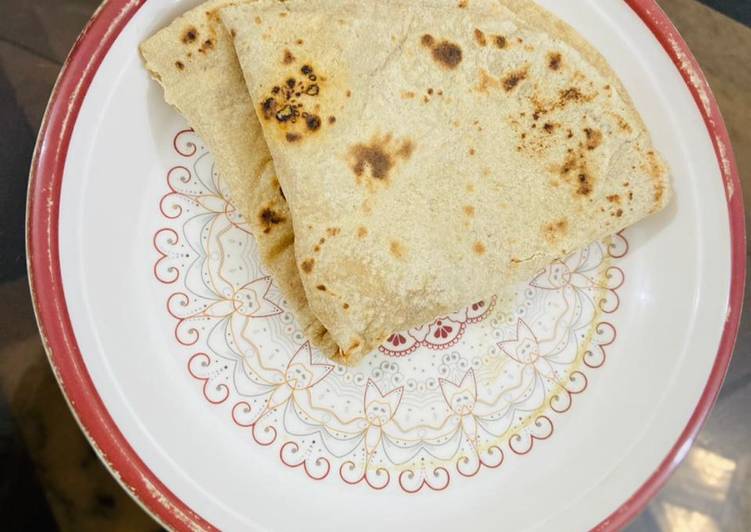
Hello everybody, hope you are having an incredible day today. Today, I will show you a way to make a distinctive dish, roti (chapati). One of my favorites food recipes. For mine, I’m gonna make it a little bit unique. This will be really delicious.
Very Detailed Roti or Chapati or Aka or Pulka Fulka (Indian soft bread). How to make Perfect Soft & layered chapathi/Soft chapati full of layers/ಮೃದುವಾದ ಚಪಾತಿ. The terms Roti and Chapati are often regularly used when it comes to Indian cooking.
Roti (Chapati) is one of the most well liked of current trending foods on earth. It is appreciated by millions every day. It’s simple, it is quick, it tastes yummy. They’re fine and they look fantastic. Roti (Chapati) is something which I’ve loved my whole life.
To get started with this particular recipe, we have to prepare a few components. You can cook roti (chapati) using 3 ingredients and 5 steps. Here is how you cook that.
Ingredients
The ingredients needed to make Roti (Chapati):
- Get 1 cup Wheat flour
- Make ready Water as a required
- Get Half tsp salt
Roti and Chapati are one and the same thing, just that the origin of the names is different. Chapati, sometimes also spelled chapatti or called roti, is an ancient unleavened flatbread that's common in Indian, East African, and Caribbean cuisine. The basic recipe includes either all white flour or a. Phulkas also known as Roti or Chapati in some regions are a whole wheat soft and thin puffed flat bread.
Instructions
Steps to make Roti (Chapati):
- Atta mein salt daal kar mix kar ka pani daal kar mix kar lain
- 10 /15 minutes mix kar rakh dain
- Phir achi terha ghond lain or is ko takreeban 10 mint tak fridge mein rakh Dein
- Phr is ki gol roti beil kar tawa par dal kar senk lain aur garam garam serve karen
- Jitni roti chahiye otna atta lay lay baqi kesi b food container mein dal kar fridge mein rakh Dein
The phulka is a daily bread for many regional Indian cuisines. It is not only rich in the nutrients and fibers. Chapati (also spelled chapathi) is an Indian flat bread that is a staple in North India and Pakistan, although today it has also made its way to South India. Like most Indian food, it's meant to be served alongside a. Roti, Chapati & Paratha are all Indian flatbreads.
So that is going to wrap this up with this exceptional food roti (chapati) recipe. Thank you very much for reading. I am sure that you can make this at home. There’s gonna be more interesting food in home recipes coming up. Remember to save this page on your browser, and share it to your family, friends and colleague. Thanks again for reading. Go on get cooking!
Print this page